
This guide provides an in-depth look at how Podbean manages ad time slots and the specific logic used to determine ad order. If you are looking for a step-by-step guide on how to set up your ad time slots, please refer to the guide: Setting Ad Time Slots for Your Podcast.
✨ Q1: How many ad time slots can I set per episode?
You can set 1 Pre-roll, 1 Post-roll, and up to 20 Mid-roll time slots for each episode.
✨ Q2: Can one time slot play multiple ads?
Yes. Each individual time slot can accommodate up to 3 ads.
✨ Q3: How is the ad playback order determined?
When multiple ads are available for the same position, Podbean uses a priority system to determine which ads play and in what order.
Level 1: Priority by Ad Type
The system generally prioritizes ads based on their source in the following order:
- PodAds (DAI) Campaign Ads
Ads from PodAds campaigns you create using your own uploaded audio files. - Ads Marketplace Campaign Ads
Ads you receive through the Podbean Ads Marketplace. These refer to ads from direct campaigns created within the Marketplace. - PodAds VAST Ads
Ads from PodAds campaigns you create using VAST URLs. - Ads Marketplace VAST Ads
Ads you receive through the Podbean Ads Marketplace. These refer to programmatic ads sourced from 3rd-party DSPs via VAST.
Level 2: Priority Within the Same Type
If multiple ads of the same type are available, the order is determined as follows:
- For PodAds (Direct & VAST):
Priority is based on the Priority Level (1–10) you assigned to the campaign. Higher numbers indicate higher priority (e.g., Level 10 plays before Level 1). If levels are equal, the earliest created campaign takes priority.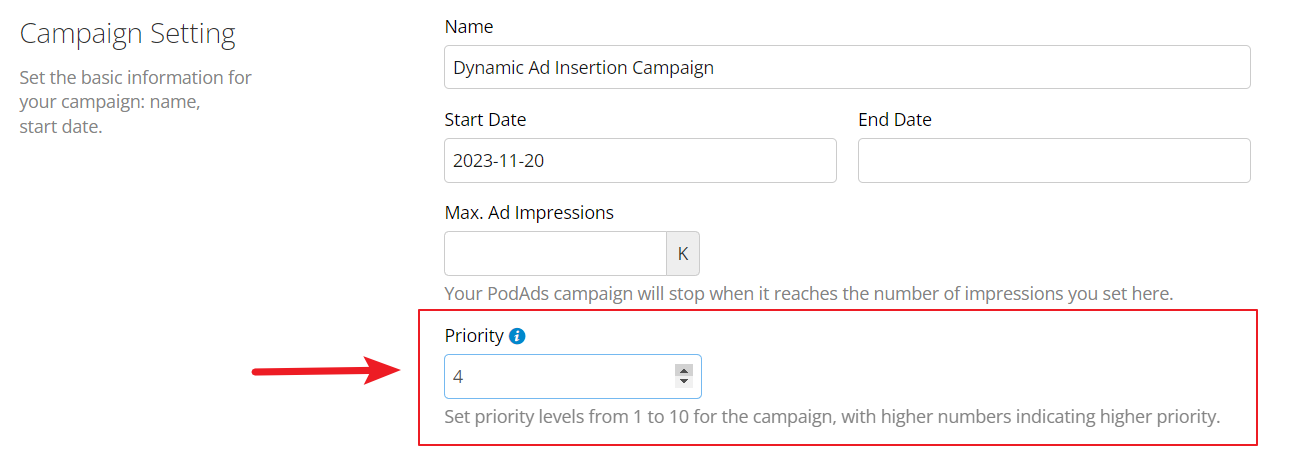
- For Ads Marketplace (Direct & VAST):
Priority is determined by CPM (Cost Per Thousand Impressions). Ads with a higher CPM play first.
✨ Q4: How are ads distributed across multiple mid-roll slots?
If you have set multiple mid-roll time slots for an episode and multiple mid-roll ads are available, the system automatically distributes the ads as evenly as possible across those slots to ensure a balanced listener experience.
✨ Examples & Illustrations
To see these rules in action, let's look at a few examples:
Example 1:
- Scenario:
You set one pre-roll time slot at 00:00, but there are 4 available ads (A, B, C, and D, in order of priority). - What happens:
At the start of your episode, your listeners will hear ads A, B, and C in a row. Since each slot can only hold up to 3 ads, D will not play.
Example 2:
- Scenario:
You set two mid-roll time slots (at 10:00 and 20:00), and there are 3 available ads (A, B, and C, in order of priority). - What happens:
To keep things balanced, the system will play ads A and B at the 10:00 mark, and C at the 20:00 mark.
Example 3:
- Scenario:
You set three mid-roll time slots (at 10:00, 20:00, and 30:00), and there are 3 available ads (A, B, and C, in order of priority). - What happens:
The ads will be distributed evenly: ad A plays at 10:00, B plays at 20:00, and C plays at 30:00.